 English
 Français
 Español
 عربى
عربىIndustry News
Home / News / Industry News / What Should You Know Before Specifying a Medium-Voltage Indoor Vacuum Circuit Breaker?


Content
A medium-voltage indoor vacuum circuit breaker (MV VCB) is a switching and protection device designed to interrupt fault currents and isolate electrical circuits operating in the medium-voltage range — typically between 1 kV and 52 kV. The defining characteristic of this technology is its arc-quenching mechanism: the electrical arc generated when the contacts separate is extinguished inside a sealed vacuum interrupter, where the absence of gas molecules prevents the arc from sustaining itself beyond the current zero crossing. This vacuum interruption principle produces extremely fast and clean arc extinction, with minimal contact erosion and no requirement for insulating gas or oil as an interrupting medium.
The "indoor" designation indicates that these breakers are engineered for installation inside metal-clad switchgear cubicles, switchrooms, or enclosed substations where environmental conditions — temperature, humidity, dust, and pollution — are controlled or partially controlled. This distinguishes them from outdoor vacuum circuit breakers mounted on poles or in open-air substations, which require additional weatherproofing and UV-resistant enclosures. MV indoor VCBs are among the most widely deployed protection devices in industrial power distribution, utility secondary substations, commercial buildings, data centers, and infrastructure facilities worldwide.
The vacuum interrupter is the heart of the circuit breaker. It consists of two copper-chromium alloy contacts — one fixed and one moving — housed inside a ceramic or glass envelope evacuated to a pressure of approximately 10⁻³ to 10⁻⁴ Pa. When the breaker receives a trip signal, a spring-charged or electromagnetic operating mechanism drives the moving contact away from the fixed contact at high speed. As the contacts separate, the current continues to flow momentarily through a metal vapor arc sustained by the evaporation of contact material.
Because there are virtually no gas molecules present in the vacuum gap, the arc plasma cannot be thermally sustained once the current passes through its natural zero crossing, which occurs 100 times per second on a 50 Hz system. At that zero crossing, the arc extinguishes and the vacuum gap recovers its dielectric strength in microseconds — far faster than air, SF₆, or oil interrupters. This rapid dielectric recovery is what allows vacuum circuit breakers to interrupt short-circuit currents of 25 kA, 31.5 kA, or 40 kA within a fraction of a cycle, limiting fault energy and minimizing damage to downstream equipment. The copper-chromium contact material is specifically chosen to minimize contact welding, produce a diffuse arc that spreads evenly across the contact face, and resist erosion over tens of thousands of operating cycles.
Selecting the correct MV indoor vacuum circuit breaker requires a clear understanding of the rated parameters that define its operational envelope. The following table summarizes the most critical specifications and their practical significance:
| Parameter | Typical Range | Practical Significance |
| Rated voltage (Ur) | 3.6 kV – 40.5 kV | Must exceed the highest system voltage at the installation point |
| Rated normal current (Ir) | 630 A – 4000 A | Continuous current the breaker can carry without overheating |
| Rated short-circuit breaking current (Isc) | 16 kA – 63 kA | Maximum fault current the breaker can safely interrupt |
| Rated short-time withstand current (Ik) | 16 kA – 63 kA (1–3 s) | Fault current the closed breaker can carry without damage during upstream clearing |
| Rated frequency | 50 Hz or 60 Hz | Must match system frequency; affects current zero crossing timing |
| Mechanical endurance | 10,000 – 30,000 operations | Total no-load operations before mechanism overhaul is required |
| Electrical endurance | 30 – 100 full-load operations | Number of rated-current interruptions before contact inspection is needed |
The short-circuit breaking current is the parameter most frequently undersized during procurement. The prospective fault level at the installation point must be calculated from the upstream transformer impedance, cable impedance, and system configuration — not estimated from nameplate ratings alone. Installing a breaker with insufficient Isc rating at a high-fault-level bus is a serious safety risk: the breaker may fail to interrupt the fault, sustaining arcing that can cause an arc flash explosion inside the switchgear cubicle.
The operating mechanism that drives contact separation and closure is a critical reliability factor. Two designs dominate the MV indoor VCB market.
The spring-charged (stored energy) mechanism uses a set of pre-compressed springs to drive both the closing and opening strokes independently. An electric motor or manual handle charges the closing spring; when a close command is issued, the spring releases its energy to drive the contacts closed and simultaneously charges the opening spring. The opening spring releases on a trip command, driving the contacts apart. This independent energy storage means the breaker can perform a full open-close-open (O-CO) duty cycle without relying on control power supply availability during the open stroke — a critical requirement for protection applications where the breaker must trip even if the auxiliary power supply has failed. Spring-charged mechanisms have a long and well-documented service history and are the default choice for most switchgear applications.
The magnetic actuator mechanism replaces mechanical springs with a permanent magnet and an electromagnetic coil. A short current pulse through the coil either attracts or repels the actuator to drive opening or closing, and the permanent magnet holds the contacts in position without continuous power consumption. Magnetic actuators have fewer moving parts than spring mechanisms — typically fewer than 10 moving components compared to over 100 in a spring drive — which proponents argue results in higher mechanical reliability and lower maintenance requirements over a 25-to-30-year service life. The limitation is that opening requires a pulse of stored energy from a capacitor bank, which must remain charged; loss of the capacitor charge source can prevent tripping. Magnetic actuator breakers are increasingly common in applications prioritizing very low maintenance intervals, such as network substations and underground distribution systems.
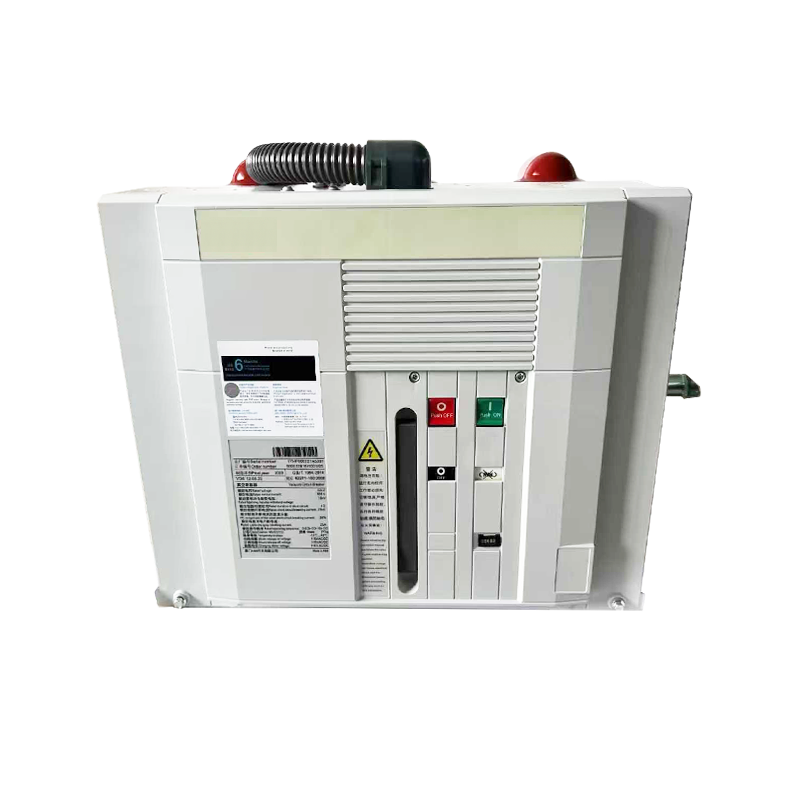
MV indoor vacuum circuit breakers are installed at switching and protection points throughout medium-voltage distribution networks. Their specific roles vary by application, but the underlying requirement — reliable fault interruption and controllable switching — is consistent across all of them.
For decades, sulfur hexafluoride (SF₆) gas circuit breakers competed directly with vacuum technology in the medium-voltage indoor market. SF₆ offers excellent dielectric properties and arc-quenching performance, but its global warming potential — 23,500 times that of CO₂ — has triggered increasingly stringent regulatory pressure in Europe, North America, and other jurisdictions. The European Union's F-Gas Regulation has set a trajectory toward phasing out SF₆ in new medium-voltage switchgear by the early 2030s, and several major switchgear manufacturers have already announced the discontinuation of SF₆-based MV products in favor of vacuum or alternative insulation technologies.
For new indoor installations, vacuum circuit breakers are the technically and commercially sound default choice across the full medium-voltage range up to 40.5 kV. They carry no environmental liability, require no gas-handling equipment or leak monitoring infrastructure, and their performance in terms of interrupting capability, mechanical endurance, and contact life is fully equal to SF₆ alternatives at the voltage levels where most indoor switchgear operates. Projects specifying SF₆ equipment today are accumulating a future replacement liability as regulations tighten and SF₆-handling certification requirements for maintenance personnel become more burdensome.
One of the practical advantages of vacuum circuit breakers is their low maintenance demand compared to earlier oil and air-blast technologies. The sealed vacuum interrupter requires no internal maintenance throughout its service life — the vacuum integrity is maintained by the ceramic or glass envelope and the metal-to-ceramic brazed joints, and cannot be field-adjusted. Manufacturers provide a simple contact wear indicator on the moving contact stem that shows the cumulative contact erosion and alerts maintenance personnel when the interrupter is approaching end of life, typically after 20 to 30 years of normal service or after the rated number of full-load electrical operations has been reached.
Routine maintenance focuses on the operating mechanism rather than the interrupter. Spring-charged mechanisms require periodic lubrication of pivot points and cam surfaces, inspection of spring set and travel distances, and functional testing of the close and trip coils. Insulation resistance testing of the interrupters and primary conductors should be performed at intervals specified by the manufacturer or by the applicable maintenance standard — IEEE C37.10 in North American practice, IEC 62271-100 in international contexts. A well-maintained vacuum circuit breaker in a clean indoor environment should provide reliable service for 25 to 30 years before a full mechanism overhaul or interrupter replacement is necessary, making the total lifecycle cost highly competitive with alternatives that require more frequent intervention.

Zhejiang Mingtuo Electrical Technology Co., Ltd. All Rights Reserved.
Electrical Protection Circuit Breakers Medium Voltage Circuit Breakers Manufacturers Low Voltage Circuit Breakers Factory
