 English
 Français
 Español
 عربى
عربىIndustry News
Home / News / Industry News / What are the latest technologies applied in outdoor vacuum circuit breakers?


Content
Outdoor vacuum circuit breakers (VCBs) are critical components in medium- and high-voltage power distribution networks. Unlike their indoor counterparts, outdoor units must endure harsh environmental conditions — UV radiation, extreme temperatures, humidity, ice, and pollution — while maintaining flawless switching performance. In recent years, the global push for smarter grids, renewable energy integration, and reduced maintenance costs has accelerated the pace of technological development in this sector. The latest innovations span materials science, digital intelligence, environmental sustainability, and mechanical design, all converging to produce breakers that are more reliable, longer-lasting, and easier to manage remotely.
The vacuum interrupter (VI) is the heart of any vacuum circuit breaker. Recent advances have focused on extending the electrical endurance and dielectric strength of the interrupter, particularly for voltages in the 36 kV to 126 kV range where outdoor applications are most demanding.
Modern vacuum interrupters now use copper-chromium (CuCr) alloys with refined microstructures produced through powder metallurgy techniques. These materials offer superior arc-quenching capability and reduced contact erosion, extending the operational life of the interrupter to over 30,000 mechanical operations and 100 or more full-load breaking operations. Some manufacturers have introduced ternary alloys such as copper-chromium-tellurium (CuCrTe) to further improve current chopping characteristics, which reduces the risk of overvoltage spikes during switching of inductive loads like transformers and motors.
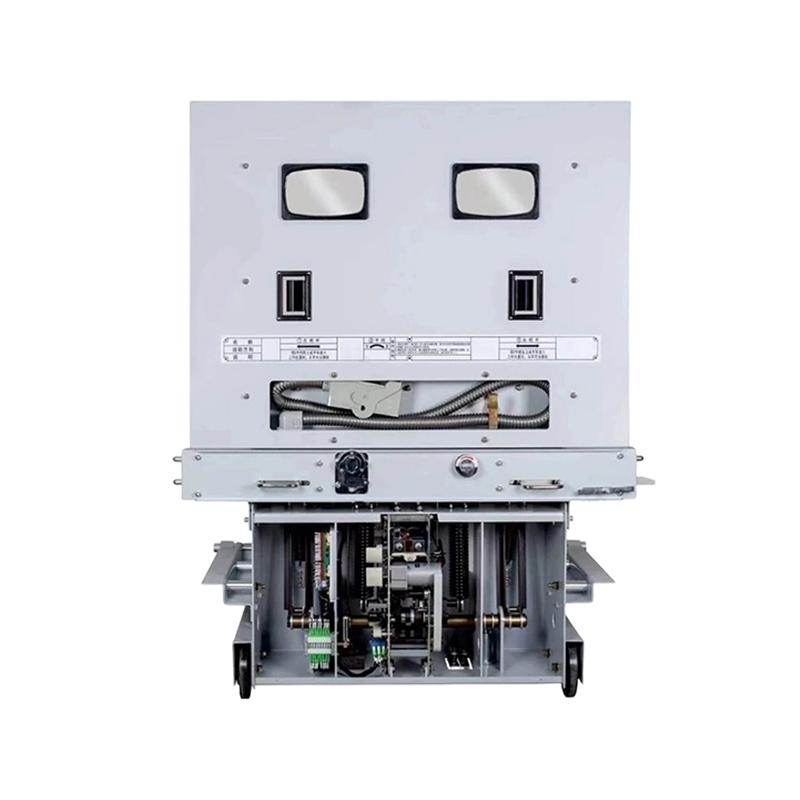
Traditional radial magnetic field (RMF) contact designs are increasingly being supplemented or replaced by axial magnetic field electrode geometries. AMF designs distribute the vacuum arc more evenly across the contact surface, significantly reducing thermal concentration and contact wear. This technology allows outdoor VCBs to handle higher rated short-circuit currents — up to 63 kA — without a proportional increase in physical size, making them ideal for high-density urban substations and industrial power systems.
One of the most disruptive developments in the outdoor circuit breaker market is the emergence of hybrid and solid-state switching architectures that combine mechanical contacts with power electronics.
Hybrid vacuum circuit breakers integrate a conventional vacuum interrupter with a parallel power electronics branch — typically using insulated gate bipolar transistors (IGBTs) or silicon carbide (SiC) thyristors. During a fault, the power electronics branch conducts the current momentarily, allowing the mechanical contacts to open without arcing. The current is then commutated back through the mechanical path and extinguished. This approach dramatically reduces arcing time and contact wear, effectively decoupling switching speed from mechanical constraints. Interruption times under 2 milliseconds have been demonstrated in laboratory conditions, compared to 20–60 ms for conventional designs.
Fully solid-state vacuum-assisted circuit breakers are also under active development for DC grid applications, where arc interruption is inherently more difficult due to the absence of natural current zero crossings. These designs are increasingly relevant as DC microgrids and offshore wind farms require reliable DC protection equipment.
Digitalization is arguably the most commercially significant trend in outdoor VCB development. Power utilities and industrial operators are demanding real-time health monitoring and predictive maintenance capabilities that reduce unplanned outages and operational costs.
Modern outdoor vacuum circuit breakers are increasingly fitted with integrated sensor packages that continuously monitor the following parameters:
These sensor signals are processed by on-board microcontrollers and transmitted via IEC 61850 GOOSE messaging or IIoT protocols such as MQTT to SCADA systems or cloud-based asset management platforms. Utilities can now track the remaining life of individual breakers in real time, scheduling maintenance only when genuinely required rather than on fixed calendar intervals.
Several leading manufacturers have deployed machine learning algorithms trained on large historical datasets of breaker sensor readings and failure events. These models can identify subtle deviations in operating coil current signatures or contact travel curves that precede mechanical failures by weeks or months. Field trials have demonstrated false-alarm rates below 5% and detection rates exceeding 90% for incipient mechanism faults, providing compelling evidence that AI-driven condition monitoring can substantially reduce outage risk in critical outdoor installations.
The traditional use of SF₆ (sulfur hexafluoride) gas as an insulating and arc-quenching medium in outdoor switchgear has come under intense regulatory pressure due to its extremely high global warming potential — approximately 23,500 times that of CO₂ over a 100-year period. While outdoor vacuum circuit breakers do not use SF₆ in the vacuum interrupter itself, SF₆ has historically been used in the surrounding enclosure or dead-tank designs for voltage grading and insulation.
The industry is responding with several alternative approaches:
| Alternative Medium | GWP vs CO₂ | Application Status |
| Clean Air (N₂/O₂ mix) | ~0 | Commercially available up to 145 kV |
| g³ (Green Gas for Grid) | <1 | In commercial rollout for GIS |
| Dry Air with solid insulation | ~0 | Growing adoption in compact outdoor units |
| C4 fluoronitrile mixtures | <2300 | Niche high-voltage applications |
Epoxy resin and silicone rubber encapsulation of current-carrying parts is also gaining traction, enabling fully solid-insulated outdoor VCBs that require no pressurized gas at all. These designs are especially well-suited to coastal and high-pollution environments where gas-sealed housings can be compromised over time.
The operating mechanism is one of the most maintenance-intensive components of any circuit breaker. Conventional spring-charged mechanisms involve dozens of moving parts — latches, pawls, toggles, and dashpots — each of which can wear or fail independently. The latest outdoor VCBs are adopting electromagnetic (EM) permanent magnet actuators (PMAs) as a more elegant alternative.
A permanent magnet actuator uses a single moving coil interacting with a fixed permanent magnet to drive the contact rod in both opening and closing directions. The mechanism holds the contacts in both the open and closed positions through magnetic force alone, without the need for mechanical latches. This reduces the total number of moving parts from over 50 in a conventional spring mechanism to fewer than 10, dramatically improving reliability and reducing maintenance requirements. Manufacturers report mean times between failures (MTBF) exceeding 25 years for PMA-equipped outdoor breakers under normal operating conditions.
The rapid expansion of distributed renewable energy — solar farms, wind parks, and battery storage — is creating demand for outdoor VCBs that can be deployed quickly, in large numbers, and in constrained physical spaces. Manufacturers are responding with pole-mounted and compact pad-mounted designs that integrate the vacuum interrupter, operating mechanism, current and voltage transformers, and protection relay into a single factory-assembled and tested unit.
These integrated recloser and sectionalizer products can be installed on distribution poles in a matter of hours, compared to days for traditional substation-based switchgear. They support automatic fault isolation and service restoration through FDIR (Fault Detection, Isolation and Restoration) algorithms, which are becoming essential tools for utilities managing increasingly complex distribution networks with bidirectional power flows from rooftop solar and vehicle-to-grid systems.
Outdoor vacuum circuit breaker technology is undergoing a profound transformation driven by the converging demands of grid modernization, environmental regulation, and digital intelligence. From advanced copper-chromium contact alloys and axial magnetic field interrupters to AI-powered condition monitoring and SF₆-free insulation systems, each innovation addresses a real operational challenge faced by power utilities and industrial operators. As grids become more complex and the cost of outages continues to rise, investment in these latest-generation outdoor VCBs represents not just a capital expenditure but a strategic commitment to resilience, sustainability, and long-term operational efficiency.
Zhejiang Mingtuo Electrical Technology Co., Ltd. All Rights Reserved.
Electrical Protection Circuit Breakers Medium Voltage Circuit Breakers Manufacturers Low Voltage Circuit Breakers Factory
