 English
 Français
 Español
 عربى
عربىIndustry News
Home / News / Industry News / What Should You Know Before Choosing an Outdoor Vacuum Circuit Breaker?


Content
Outdoor vacuum circuit breakers are switching devices used in medium-voltage power distribution systems to interrupt fault currents and safely open or close circuits under load, all while housed in an enclosure rated for exposure to weather and outdoor environmental conditions. Unlike indoor breakers, which operate in controlled substation environments, outdoor units must be designed to withstand rain, temperature swings, humidity, dust, and UV exposure without compromising their electrical performance or safety rating.
These breakers rely on a vacuum interrupter, a sealed chamber where the electrical arc formed during circuit interruption is extinguished almost instantly due to the absence of air or gas to sustain it. This design has made vacuum circuit breakers the dominant choice for medium-voltage applications, largely replacing older oil and air-blast breaker technologies due to their compact size, minimal maintenance needs, and long operational lifespan.
Inside a vacuum circuit breaker, two contacts, one fixed and one moving, are housed within a sealed vacuum interrupter bottle. When the breaker needs to interrupt current, the moving contact separates from the fixed contact, and an arc briefly forms between them as the current continues to flow across the gap. Because the surrounding vacuum has virtually no gas molecules to ionize and sustain the arc, it extinguishes extremely quickly, typically within one or two cycles of the alternating current waveform.
This rapid arc extinction is what makes vacuum breakers so effective at interrupting even significant fault currents without the extensive contact erosion or maintenance demands associated with older breaker technologies. Because the vacuum interrupter is a sealed unit, it also requires no gas replenishment or oil replacement over its service life, significantly reducing the ongoing maintenance burden compared to older breaker designs.
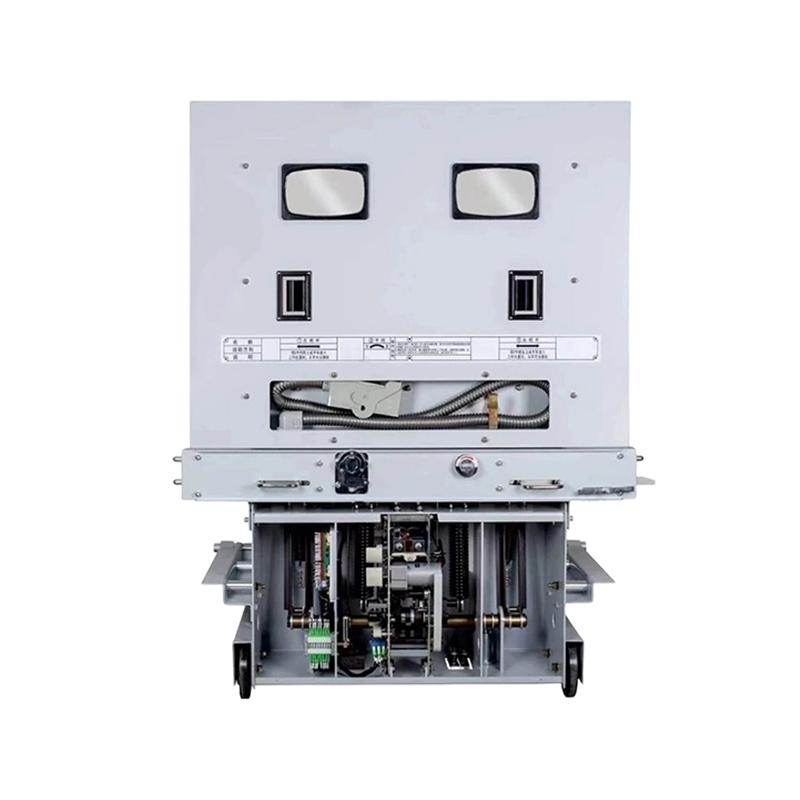
When evaluating outdoor vacuum circuit breakers for a specific application, several electrical ratings determine whether a given model is suitable for the intended power system.
| Specification | What It Indicates |
| Rated Voltage | Maximum system voltage the breaker can safely operate on, typically 15kV to 38kV for outdoor units |
| Rated Current | Continuous current-carrying capacity under normal operating conditions |
| Interrupting Capacity | Maximum fault current the breaker can safely interrupt, expressed in kA |
| Rated Frequency | Typically 50Hz or 60Hz, depending on regional grid standards |
| BIL Rating | Basic Insulation Level, indicating the breaker's ability to withstand voltage surges from lightning or switching events |
Confirming these ratings against the specific requirements of the power system, including expected fault current levels and system voltage, is essential before selecting a breaker for installation, since an undersized breaker can fail catastrophically during a fault event.
Because outdoor vacuum circuit breakers are directly exposed to the elements, their enclosure design and environmental protection rating are just as important as their electrical specifications. Most outdoor breakers carry an IP (Ingress Protection) rating that indicates their resistance to dust and water intrusion, with IP54 or higher commonly specified for outdoor pole-mounted or pad-mounted installations.
Additional protective features found in many outdoor units include corrosion-resistant coatings on metal enclosures, weatherproof gaskets around access panels, and internal heating elements designed to prevent condensation buildup in humid or cold climates. In regions with heavy snowfall, ice, or extreme temperature swings, selecting a breaker specifically rated for the local climate zone helps prevent operational issues like frozen mechanisms or seal degradation over time.
Outdoor vacuum circuit breakers are used across a wide range of medium-voltage power infrastructure where indoor switchgear installation isn't practical or cost-effective.
Electric utilities rely heavily on outdoor vacuum breakers at distribution substations to protect feeder lines and isolate faults, helping limit the scope and duration of power outages when problems occur on the distribution network.
Industrial facilities and mining sites often use outdoor vacuum breakers to protect large motors, transformers, and other critical equipment operating on medium-voltage circuits, particularly in remote locations where indoor switchgear housing isn't feasible.
Solar farms and wind installations frequently use outdoor vacuum circuit breakers to protect the medium-voltage collection systems that gather power from multiple generation units before stepping it up for transmission, since these installations are almost always located outdoors across large areas.
While vacuum circuit breakers require significantly less maintenance than older breaker technologies, outdoor units still benefit from a regular inspection schedule to account for their exposure to environmental stress. Key maintenance tasks include the following.
Following the manufacturer's recommended inspection intervals, typically annually or biannually depending on the operating environment, helps catch early signs of wear or environmental damage before they lead to a breaker failure during an actual fault event.
Selecting an appropriate outdoor vacuum circuit breaker starts with clearly defining the electrical requirements of the system, including operating voltage, expected load current, and maximum anticipated fault current. From there, matching the enclosure's environmental protection rating to local climate conditions helps ensure long-term reliability without excessive maintenance demands.
Working with a qualified electrical engineer to review system single-line diagrams and confirm coordination with upstream and downstream protective devices is strongly recommended before finalizing a breaker selection, since proper protection coordination is essential for the breaker to function correctly as part of the broader power system's safety design.

Zhejiang Mingtuo Electrical Technology Co., Ltd. All Rights Reserved.
Electrical Protection Circuit Breakers Medium Voltage Circuit Breakers Manufacturers Low Voltage Circuit Breakers Factory
