 English
 Français
 Español
 عربى
Industry News
Home / News / Industry News / What Is a Moulded Case Circuit Breaker (MCCB)? A Complete Guide for Buyers


Content
If you have ever opened an industrial distribution board, you have seen them: sturdy grey breakers with a toggle handle and a printed rating such as 250 A or 630 A. These are moulded case circuit breakers, or MCCBs, and they fill the gap between the small miniature breakers that protect final circuits at home and the large open-frame air circuit breakers that sit at the incoming of a substation. In this guide, our engineering team explains what an MCCB is, how it trips, what the numbers on the nameplate actually mean, and how to select one that will still be reliable ten years from now.
A moulded case circuit breaker is an electrical protection device in which the current-carrying parts, the switching mechanism and the trip unit are all enclosed inside a moulded insulating housing. That housing, normally a glass-fibre reinforced thermosetting polymer, is where the product gets its name. The sealed case keeps dust, moisture and fingers away from live parts, and it also helps to contain and cool the arc that forms when the contacts open under fault current.
Functionally, an MCCB does three jobs at once. It carries the normal load current of a circuit day after day, it switches that circuit on and off by hand, and it opens automatically when the current rises to a level that would damage cables, busbars or connected equipment. Because it is a self-contained device, it can be mounted directly inside a switchboard without any external sensing or control wiring.
Most MCCBs are rated between 16 A and 1600 A, with larger frames reaching 2500 A or 3200 A. Rated voltages commonly cover 240 V, 415 V and 690 V AC, and dedicated DC versions are available for photovoltaic and battery systems. The two standards you will meet most often are IEC 60947-2 internationally and UL 489 in North America. You may also see the American spelling, molded case circuit breaker; both spellings describe exactly the same device.
Inside the case, two different sensing principles usually work side by side, which is why the classic device is called a thermal-magnetic breaker.
A bimetal strip carries the load current and heats up in proportion to it. On a mild but sustained overload, for example a motor drawing 1.3 times its rated current for several minutes, the strip bends gradually until it releases the latch. Because the movement is driven by heat, the breaker trips faster at higher currents and slower at lower ones, producing the inverse-time curve printed on every datasheet. This is what protects cables from slow thermal damage.
A short circuit produces a current many times the rated value. A coil around the conductor generates a strong magnetic field that pulls the trip mechanism open almost instantly, typically within 10 to 20 milliseconds. This is the instantaneous part of the curve, and it exists to clear a fault before the cable or the switchboard is destroyed.
Every MCCB has a handle with three positions: ON, OFF and TRIPPED. The tripped position is deliberately different from OFF, so an operator can see that the breaker did not simply get switched off by hand. For panels that are difficult to reach, MCCBs accept rotary handles, motor operators, undervoltage and shunt-trip releases, plus auxiliary contacts that report status back to a control system.
Above roughly 400 A, thermal-magnetic sensing becomes bulky and difficult to adjust accurately, so manufacturers switch to electronic trip units. Current transformers measure the current, a microprocessor compares it with the chosen settings, and a small magnetic actuator opens the contacts. The advantage is precision and flexibility: engineers can set long-time, short-time, instantaneous and earth-fault thresholds separately, and often add a communication module for monitoring.
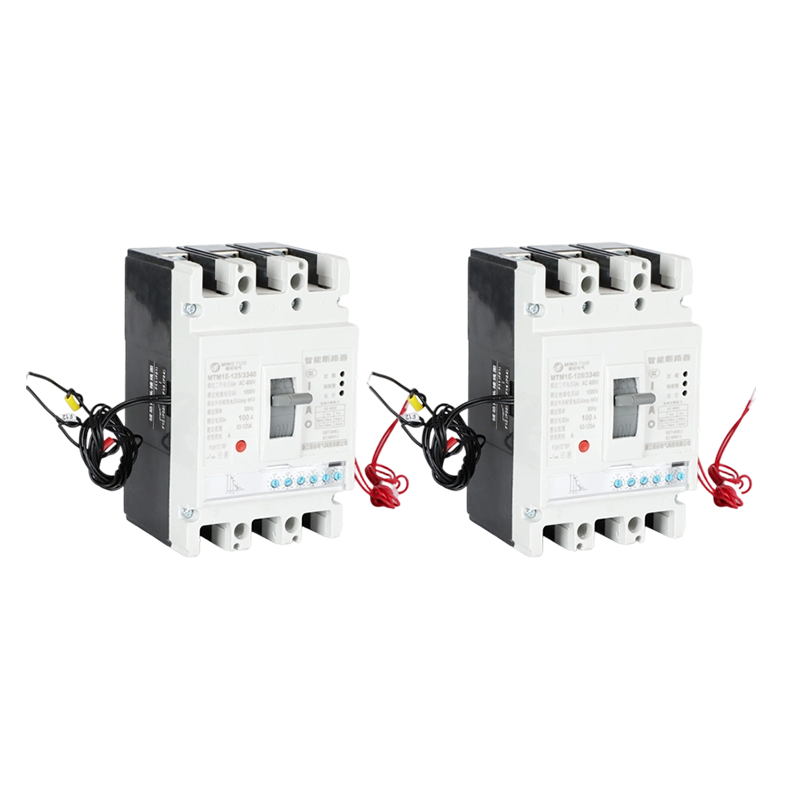 MT-M1 Digital Electronic MCCB, 100-800A, 3/4P, 50kA, Microprocessor-Controlled Circuit BreThe MT-M1 Digital Electronic MCCB represents the next generation of circuit protection, integrating precision microprocessor control with robust molded case constructi...View Product →
It helps to place the moulded case breaker beside the two devices it is most often confused with.
| Feature | MCB | MCCB | ACB |
|---|---|---|---|
| Typical current range | Up to 125 A | 16 A to 1600 A | 630 A to 6300 A |
| Interrupting capacity | 6 to 10 kA | 25 to 100 kA | 65 to 150 kA |
| Trip unit | Fixed thermal-magnetic | Thermal-magnetic or electronic | Electronic, often with communication |
| Adjustable settings | Rare | Common | Extensive |
| Typical use | Final circuits, lighting, sockets | Feeders, sub-mains, motor circuits | Main incoming, bus-tie, generator |
| Mounting | DIN rail | Fixed, plug-in or draw-out | Draw-out in switchgear |
The family is broader than most people expect, because the same case size can hold very different trip units and accessories.
Our own EZC series is built for exactly this general-purpose role, covering 100 A to 1600 A with 3-pole and 4-pole options for low voltage power distribution.
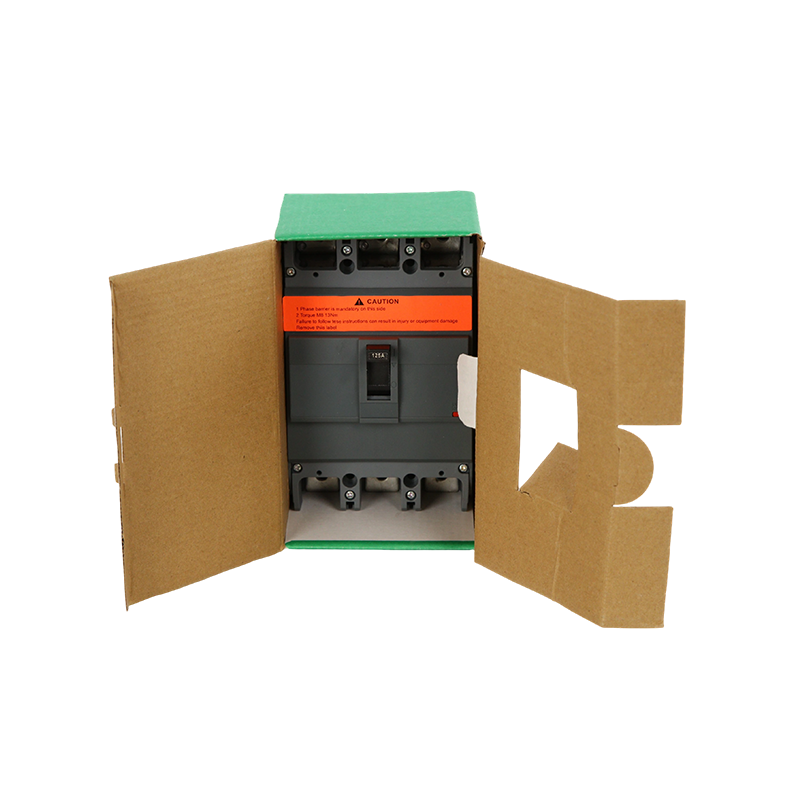 EZC Molded Case Circuit Breaker 100A–1600A for Low-Voltage Power DistributionThe EZC Molded Case Circuit Breaker 100A–630A is designed for low-voltage power distribution systems where dependable circuit protection and practical installation are...View Product →
This is the current the breaker can carry continuously at a reference ambient temperature, usually 40 degrees Celsius. In a hot plant room, a 250 A breaker may need to be derated, which is why manufacturers publish temperature correction tables.
Icu is the ultimate short-circuit current the breaker can interrupt once, after which it may no longer be fit for service. Ics is the rating it can interrupt repeatedly and still keep working. Specifying only Icu while ignoring Ics is one of the most common mistakes in switchboard design.
The rated voltage must be at least as high as the system voltage, and the number of poles must match the earthing arrangement. Three-pole devices suit most three-phase loads; four-pole devices are used where neutral switching or protection is required.
The curve determines how quickly the breaker reacts at each current level. Motor circuits need a curve that rides through starting surges, while cable feeders need one that trips before the conductor overheats. For larger ratings, our NSX range from 800 A to 1600 A gives designers the flexibility to fine-tune those thresholds on site.
 MT-NSX 3/4P 800A-1600A AC Molded Case Circuit Breaker for Industrial & Commercial DistribuThe MT-NSX series molded case circuit breakers (MCCBs) provide reliable and versatile protection for low-voltage electrical systems, widely adopted in industrial plant...View Product →
MCCBs appear wherever medium-sized currents have to be distributed and protected. Typical locations include factory main and sub-distribution boards, commercial building risers, data centre power trains, hospital essential supplies, water treatment plants and solar farms. They protect outgoing feeder cables, feed motor control centres, act as the load-side device in generator changeover schemes and serve as the main breaker in compact package substations. Wherever selectivity matters, an MCCB is usually the device that coordinates with the breakers above and below it. You can explore the wider context of protective devices in our guide to low and medium voltage electrical protection.
Choosing the device is only half the job; choosing the supplier is the other half. Mingtuo Electric is a technology-driven manufacturer based in Liushi, working across low voltage and medium voltage protection. Our product range covers moulded case circuit breakers, air circuit breakers, vacuum circuit breakers, automatic transfer switches, contactors, current transformers and industrial waterproof socket boxes, supported by a manufacturing chain that runs from component machining to final assembly and by a 7S management system aimed at stable quality and low return rates. If you are specifying distribution equipment for an industrial, commercial or residential project, our engineers are happy to help with selection, derating and customised solutions. You can learn more about our factory, quality control and service commitments on the Mingtuo Electric about page, or send us your project parameters for a quotation.
Zhejiang Mingtuo Electrical Technology Co., Ltd. All Rights Reserved.
Electrical Protection Circuit Breakers Medium Voltage Circuit Breakers Manufacturers Low Voltage Circuit Breakers Factory
