 English
 Français
 Español
 عربى
عربى

Vacuum Circuit Breakers Explained: How They Work & Why
Content
- 1 What Is a Vacuum Circuit Breaker and How Does It Work?
- 2 Key Components of a Vacuum Circuit Breaker
- 3 Voltage and Current Ratings: Where Vacuum Breakers Are Applied
- 4 Advantages of Vacuum Circuit Breakers Over Competing Technologies
- 5 Limitations and Challenges to Be Aware Of
- 6 Applications Across Industries and Grid Segments
- 7 Maintenance Practices That Maximize Vacuum Breaker Reliability
Modern power grids demand switching and protection equipment that can interrupt fault currents quickly, reliably, and repeatedly — without excessive maintenance or environmental impact. Vacuum circuit breakers (VCBs) have become the dominant technology for medium-voltage switchgear precisely because they meet all of these demands. Found in utility substations, industrial plants, commercial buildings, and renewable energy installations worldwide, vacuum circuit breakers represent a mature yet continually advancing technology that electrical engineers, facility managers, and grid operators rely on daily. This article explains how they work, what makes them superior to alternatives, and how to apply and maintain them effectively.
What Is a Vacuum Circuit Breaker and How Does It Work?
A vacuum circuit breaker is a type of circuit breaker in which the arc quenching — the process of extinguishing the electrical arc that forms when contacts separate under load — takes place inside a sealed vacuum interrupter. The vacuum interrupter is the heart of the device: a ceramic or glass envelope that maintains an internal pressure of approximately 10⁻⁶ to 10⁻⁴ mbar, a level of vacuum far more extreme than what a mechanical pump alone can achieve in normal industrial settings.
When the breaker receives a trip signal — either from a protective relay detecting a fault or from a manual operation — a spring-charged mechanism drives the moving contact away from the fixed contact inside the vacuum interrupter. As the contacts begin to separate, the current continues to flow briefly through a metal vapor arc that forms from the contact material itself. Because there are virtually no gas molecules in the vacuum to sustain ionization, this arc exists only as a plasma of vaporized metal. At the natural current zero crossing — the point every 8.3 milliseconds in a 60 Hz system, or every 10 milliseconds in a 50 Hz system — the arc extinguishes and the dielectric strength of the vacuum gap recovers almost instantaneously. The result is successful current interruption within the first or second current zero after contact separation, giving vacuum breakers some of the fastest interruption times of any switching technology.
The contacts themselves are typically made from copper-chromium alloy, a material chosen specifically for its ability to produce a diffuse arc rather than a concentrated one. A diffuse arc distributes the energy evenly across the contact surface, minimizing erosion and extending contact life to tens of thousands of operations before replacement is required.
Key Components of a Vacuum Circuit Breaker
Understanding the individual components that make up a VCB helps clarify both its performance characteristics and its maintenance requirements. A complete vacuum circuit breaker assembly consists of several integrated subsystems working together.
The Vacuum Interrupter
The vacuum interrupter is a hermetically sealed unit containing the fixed and moving contacts, a metallic bellows that allows the moving contact to travel while maintaining the vacuum seal, and a metallic shield that prevents metal vapor from depositing on the insulating envelope during arcing. The envelope itself is made from alumina ceramic or borosilicate glass, materials chosen for their outgassing resistance — meaning they do not release trapped gases under high vacuum conditions that would degrade the internal pressure over time. A properly manufactured vacuum interrupter maintains its rated vacuum level for the entire service life of the breaker, typically 20 to 30 years.
The Operating Mechanism
The operating mechanism stores energy in springs — either a single closing spring or separate closing and opening springs — that release their energy to drive contact motion when triggered. Spring-charged mechanisms are preferred because they provide fast, consistent contact velocity regardless of control voltage variations. Some modern designs use magnetic actuators instead of springs, using a permanent magnet to hold contacts in the open or closed position and a capacitor discharge to switch between states, offering even faster operation and fewer mechanical parts subject to wear.
Insulation System and Housing
The interrupter and live parts are supported within an insulating structure made from cast epoxy resin, which provides phase-to-phase and phase-to-ground isolation. The outer enclosure for most medium-voltage VCBs is a steel or stainless steel draw-out chassis that allows the breaker to be racked in and out of its switchgear cubicle for testing and maintenance without de-energizing adjacent circuits.
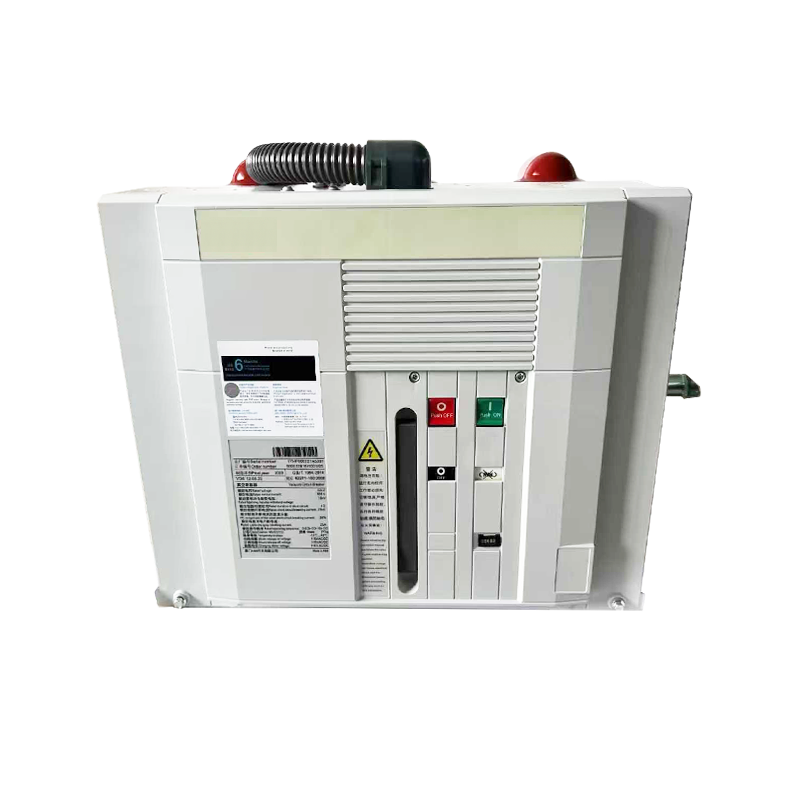
Voltage and Current Ratings: Where Vacuum Breakers Are Applied
Vacuum circuit breakers are primarily a medium-voltage technology. Their standard application range spans from 3.6 kV to 40.5 kV, covering the distribution voltage levels most widely used in utility secondary substations, industrial plants, and commercial facility switchgear. Below this range, molded-case and air circuit breakers are more economical. Above it, SF₆ gas-insulated breakers remain dominant for high-voltage transmission applications above 72.5 kV, though the boundary is gradually shifting upward as vacuum interrupter technology continues to improve.
Rated continuous current for medium-voltage VCBs typically runs from 630 A to 4000 A, while rated short-circuit interrupting current — the maximum fault current the breaker can safely interrupt — ranges from 16 kA to 63 kA depending on the design. The following table summarizes common VCB ratings and their typical application contexts:
| Rated Voltage | Typical Continuous Current | Short-Circuit Rating | Typical Application |
| 3.6 – 7.2 kV | 630 – 2000 A | 16 – 31.5 kA | Industrial MV switchgear, motor control |
| 12 – 15 kV | 1250 – 3150 A | 25 – 50 kA | Utility distribution substations |
| 24 kV | 1600 – 4000 A | 31.5 – 50 kA | Sub-transmission, large industrial |
| 36 – 40.5 kV | 1600 – 4000 A | 31.5 – 63 kA | Primary substations, wind/solar farms |
Advantages of Vacuum Circuit Breakers Over Competing Technologies
Vacuum circuit breakers displaced oil circuit breakers and air blast circuit breakers in medium-voltage applications decades ago, and they continue to outperform SF₆ alternatives on several important dimensions. Understanding these advantages explains why VCBs have become the default choice for most new medium-voltage installations globally.
- Environmental Safety: Vacuum interrupters contain no hazardous gases or oils. SF₆ (sulfur hexafluoride), used in competing gas-insulated breakers, has a global warming potential 23,500 times that of CO₂ and is subject to increasingly strict regulatory controls in Europe, North America, and elsewhere. VCBs have no equivalent environmental liability, making them the preferred technology for organizations with sustainability commitments.
- Low Maintenance Requirements: With no oil to degrade, no gas pressure to monitor, and contacts designed for 10,000 to 30,000 mechanical operations, vacuum breakers require minimal scheduled maintenance. Routine checks involve verifying mechanism spring charge status, inspecting insulation surfaces, and periodically testing contact resistance — tasks that can often be performed without removing the breaker from service.
- Compact Dimensions: The vacuum interrupter's small physical size compared to equivalent oil or gas equipment allows VCB-based switchgear to be designed in compact, metal-enclosed cubicles suitable for installation in space-constrained locations such as urban substations, building basements, and offshore platforms.
- Fast Fault Interruption: The near-instantaneous dielectric recovery of the vacuum gap after current zero allows VCBs to interrupt fault currents within one to two cycles, limiting the duration of fault energy and reducing mechanical and thermal stress on cables, transformers, and bus systems connected to the fault circuit.
- No Fire Risk: Unlike oil circuit breakers, which present a fire and explosion hazard if the oil overheats or if a catastrophic failure ruptures the tank, vacuum breakers contain no flammable materials. This makes them suitable for installation inside occupied buildings and in fire-sensitive environments without the need for oil containment pits or blast walls.
- Long Service Life: A well-maintained vacuum circuit breaker can remain in service for 25 to 30 years with vacuum interrupter replacement at approximately the midpoint of its life, making the total lifecycle cost highly competitive against alternatives that require more frequent major maintenance.
Limitations and Challenges to Be Aware Of
No technology is without limitations, and vacuum circuit breakers are no exception. Understanding their constraints is important for correct application and system design.
The most significant technical limitation of VCBs is their tendency to produce voltage spikes — called voltage escalation or restriking overvoltages — when switching small inductive currents such as unloaded transformer magnetizing currents or motor no-load currents. When a VCB chops the current before natural current zero (current chopping), the energy stored in the inductance of the circuit is suddenly forced into the circuit's stray capacitance, generating an oscillating overvoltage that can reach several times the system voltage. For sensitive equipment such as dry-type transformers, motors, and generators, these overvoltages can cause insulation stress and accelerated aging. Surge suppressors, surge capacitors, or RC snubber networks connected at the equipment terminals are standard mitigation measures when VCBs are used in these switching duties.
Vacuum integrity is another consideration. Although modern vacuum interrupters are extremely reliable in maintaining their internal vacuum over decades, a loss of vacuum — caused by a manufacturing defect, mechanical damage, or seal failure — renders the interrupter unable to quench arcs, potentially causing a catastrophic failure during a fault interruption attempt. Routine vacuum integrity testing using a high-frequency high-voltage test set (the "HV test" or "Hipot" test) is recommended during periodic maintenance to verify interrupter condition before a failure occurs in service.
Applications Across Industries and Grid Segments
The versatility of vacuum circuit breakers has made them ubiquitous across virtually every segment of the electrical power infrastructure. Their applications span a wide range of environments and operating conditions.
Utility Distribution Substations
In utility distribution substations operating at 11 kV, 13.8 kV, 15 kV, or 33 kV, vacuum circuit breakers serve as the primary feeder protection and bus sectionalizing equipment. They operate under control of digital protective relays that detect overcurrents, earth faults, and differential faults, tripping the breaker within milliseconds of fault detection. The high interrupting duty cycle — the ability to interrupt rated fault current multiple times without maintenance — is particularly valued in utility feeders that may experience frequent fault events due to wildlife contacts, vegetation, or weather-related events.
Industrial Power Systems
Large industrial facilities — petrochemical plants, steel mills, cement plants, data centers, and mining operations — use vacuum circuit breakers extensively in their medium-voltage switchgear for motor starting and protection, transformer switching, bus tie applications, and generator paralleling. The frequent switching operations that characterize industrial power systems (motor starts, load transfers, bus reconfiguration) are well within the operational life capability of modern VCBs, and their compact size suits the metal-clad switchgear lineups typical of industrial electrical rooms.
Renewable Energy Integration
Wind farms and utility-scale solar installations require medium-voltage collection systems to aggregate power from individual generators and step it up to transmission voltage. Vacuum circuit breakers protect the medium-voltage collection feeders and the high-side of wind turbine step-up transformers. Their low maintenance requirements are particularly valuable in remote renewable sites where access for maintenance is difficult and costly, and their environmental cleanliness suits the sustainability mission of renewable energy projects.
Maintenance Practices That Maximize Vacuum Breaker Reliability
While vacuum circuit breakers are notably low-maintenance compared to oil and gas alternatives, a structured maintenance program is still essential for ensuring reliable operation over their full service life. Neglecting maintenance does not eliminate the risk of failure — it simply delays the discovery of developing problems until a critical moment.
- Contact Resistance Testing: Measure the contact resistance through each pole using a micro-ohmmeter or DLRO instrument. Values significantly above the manufacturer's specification (typically below 50 to 100 microohms) indicate contact wear, contamination, or loss of contact pressure requiring investigation.
- Vacuum Integrity Testing: Apply a high-frequency high-voltage test at the rated dielectric test level across the open contacts of each interrupter to verify vacuum integrity. A glow discharge or breakdown indicates loss of vacuum requiring immediate interrupter replacement.
- Timing Tests: Use a circuit breaker analyzer to measure contact opening and closing times, contact bounce, and synchronism between phases. Deviations from specification indicate mechanism wear, spring fatigue, or lubrication degradation.
- Insulation Resistance Testing: Megger testing of the insulating components — bushings, epoxy supports, and interrupter envelopes — identifies moisture ingress or surface contamination that could reduce dielectric withstand capability.
- Mechanism Lubrication: Moving parts in the operating mechanism require periodic lubrication with the specific greases recommended by the manufacturer. Using incorrect lubricants can cause stiction, mechanism sluggishness, or in extreme cases, mechanism seizure that prevents the breaker from tripping during a fault.
Most manufacturers recommend comprehensive maintenance at intervals of three to five years for breakers in normal service, with more frequent checks for breakers subject to frequent switching operations or harsh environmental conditions. Keeping detailed records of each maintenance visit — including all measured values and any corrective actions taken — provides the trend data needed to predict when components are approaching the end of their service life and schedule replacements proactively rather than reactively.
Recommended Products

Zhejiang Mingtuo Electrical Technology Co., Ltd. All Rights Reserved.
Electrical Protection Circuit Breakers Medium Voltage Circuit Breakers Manufacturers Low Voltage Circuit Breakers Factory
