 English
 Français
 Español
 عربى
Industry News
Home / News / Industry News / Miniature Circuit Breakers How They Work: Types, Ratings, and Selection Guide


Content
You install a 16 A miniature circuit breaker in a residential distribution board and assume it will simply "cut power" when something goes wrong. Then one afternoon, an overloaded socket leaves the breaker tripped, and the lights in half the house go dark. The sequence of events that leads to that click is not a simple switch operation; it is a carefully designed thermal and magnetic response that balances sensitivity with protection.
In this article, you will learn what physically happens inside an MCB during overload and short-circuit conditions, which ratings and trip curves actually matter for selection, and where buyers often make mistakes when sourcing MCBs.
A miniature circuit breaker is a compact automatic switch built around a latching mechanism. Its main components are:
When the breaker is closed, current flows through the bimetallic strip and the coil. Under normal conditions, the magnetic field from the coil is too weak to pull the armature, and the bimetallic strip remains straight. The system is quiet and stable. Only when current conditions exceed design limits does the trip sequence begin.
An MCB has two independent trip elements, each designed for a different type of fault.
An overload is a sustained current above the breaker's rated current, but well below the level of a dead short. The bimetallic strip warms up slowly. Its calibrated bending increases as the current rises, and if the overcurrent persists, the strip pushes against the latch. This gives a time-delay that prevents nuisance tripping from motor starting or other temporary inrush currents.
When short-circuit current flows, the magnetic field in the coil increases almost instantly. The solenoid pulls an armature, which releases the latch with no intentional delay. This instantaneous action is essential because the temperature rise in cables and equipment during a short circuit can be severe within milliseconds.
| Condition | Primary mechanism | Response | Time |
|---|---|---|---|
| Overload | Thermal (bimetallic strip) | Gradual bending releases latch | Seconds to minutes, depending on current |
| Short circuit | Magnetic (solenoid and armature) | Instant release of latch | Milliseconds |
Many MCB designs use a hybrid function. The same bimetallic strip that handles overload also carries current, and the magnetic coil sits around it. When both mechanisms are available, the breaker can protect against a wider range of fault conditions without relying on one thermal element alone.
The trip curve tells you when the magnetic element will operate, and therefore which loads are safe with a given breaker. The curve is chosen by the manufacturer and printed on the front enclosure.
| Curve | Magnetic trip threshold | Typical applications |
|---|---|---|
| Type B | 3-5 times rated current | Resistive loads, lighting, general household circuits |
| Type C | 5-10 times rated current | Motors, pumps, small transformers, commercial distribution |
| Type D | 10-20 times rated current | High inrush loads such as transformers, compressors, welding equipment |
Selecting a Type C breaker for a pure lighting circuit can lead to delayed operation during a fault, while selecting a Type B for a compressor could cause frequent nuisance tripping. Matching the curve to the load nature matters as much as matching the ampere rating.
For most industrial and commercial panel builders, Type C MCBs are common because they handle moderate inrush currents while still offering reasonable protection. Type D is not a substitute for correct overcurrent coordination in an installation.
When specifying or purchasing miniature circuit breakers, focus on the following parameters. These values define how safe the device will be in the real installation.
The rated current is the continuous current the breaker can carry at a specified ambient temperature without tripping. Common ratings for small circuits include 6 A, 10 A, 16 A, 20 A, 25 A, and 32 A. The breaker must be matched to cable ampacity and load demand.
Breaking capacity is the maximum short-circuit current that the breaker can interrupt without being damaged or welding its contacts. Domestic MCBs often carry 4.5 kA, 6 kA, or 10 kA at 230/400 V. If the prospective short-circuit current in your installation exceeds the breaker's breaking capacity, the device can fail dangerously during a short circuit.
MCBs are available in single-pole, double-pole, triple-pole, and four-pole forms. For single-phase systems, 1P is common; for three-phase loads, 3P or 3P+N is used. Always ensure the number of poles matches the system earthing, phase arrangement, and application.
Reliable MCBs are built against recognized standards such as IEC 60898 for domestic protection and IEC 60947-2 for industrial applications. Test reports, CE marks, and type-tested short-circuit values are concrete documents a buyer can verify. Ignoring these documents can turn a small cost saving into a serious safety or liability problem.
When evaluating a supplier, it is useful to compare the MCB's characteristic curves from the product datasheet and to ask about the actual test conditions. The physical mechanisms inside a low-cost breaker may not match the performance claimed by the label. A broader low-voltage and medium-voltage electrical protection guide can help you place MCB selection in the context of the complete distribution system.
Fuses provide overcurrent protection through melting, but they require replacement after every operation. An MCB resets after the fault is cleared, which saves downtime and avoids the need for spare fuses.
MCBs also offer more accurate discrimination: you can use B/C/D curves to decide which breaker should trip first in a cascade. Optional accessories such as shunt trips, auxiliary contacts, and undervoltage releases are not available on a standard fuse. However, MCBs are mechanical devices, so switching frequency and operation cycles matter. A good MCB should survive thousands of mechanical operations without tripping thresholds drifting.
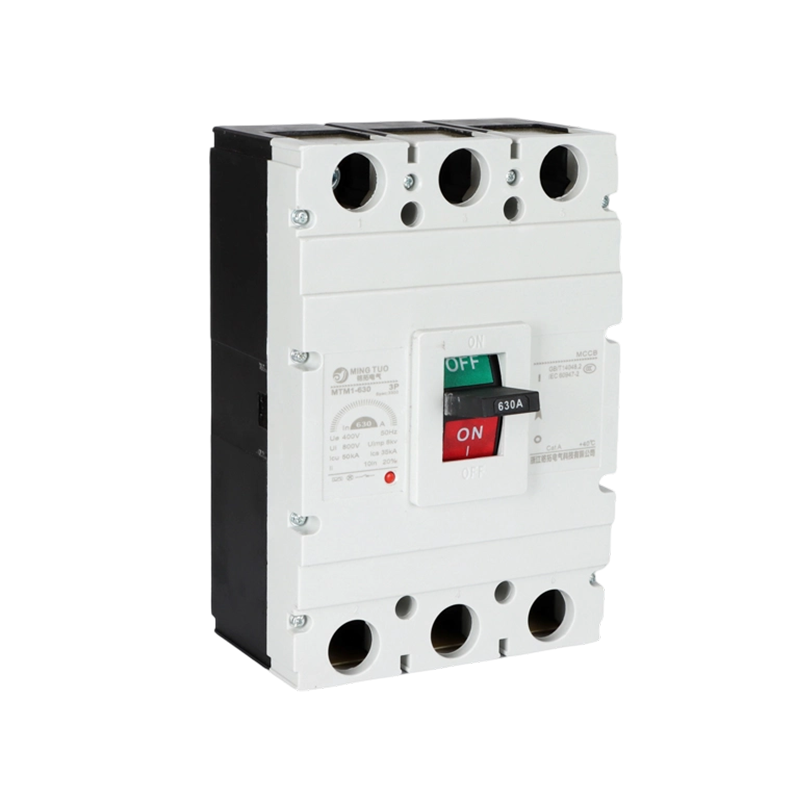
For higher current or power distribution circuits, molded case circuit breakers (MCCBs) are used instead of MCBs because they offer larger frame sizes and adjustable trip settings. Understanding where the MCB fits within the hierarchy of protection devices is important for any panel design.
A miniature circuit breaker is a component that often sits behind a panel door, but its job is fundamental. If you want to understand the manufacturing background and quality control behind a breaker supplier, it is worth examining the company's production and engineering capabilities. That check can reveal whether the supplier has real design experience or merely assembles parts from other manufacturers.
An MCB does not just "turn off" when something fails. It senses overloads through a bimetallic strip and short circuits through a magnetic coil, then releases a latch that opens the contacts. Choosing the right device requires matching rated current to the load, selecting the correct trip curve, and confirming that the breaking capacity is high enough for the installation.
Every MCB is small, but every trip event places the device under mechanical and electrical stress. Buying a miniature circuit breaker from a manufacturer with documented test data and consistent production is one of the simplest ways to protect both your panel and your reputation.
Zhejiang Mingtuo Electrical Technology Co., Ltd. All Rights Reserved.
Electrical Protection Circuit Breakers Medium Voltage Circuit Breakers Manufacturers Low Voltage Circuit Breakers Factory
