 English
 Français
 Español
 عربى
Industry News
Home / News / Industry News / Miniature Circuit Breaker Single Pole: Selection, Wiring, and Protection Guide


Content
At Mingtuo Electric, we have spent years manufacturing low-voltage and medium-voltage circuit breakers for industrial, commercial, and residential power distribution. One of the most common questions we hear from installers and project engineers is simple: what exactly does a miniature circuit breaker single pole do, and when should you choose one? The answer starts with understanding that a single-pole MCB is not a miniature version of a large industrial breaker. It is a dedicated final-circuit device, usually one module wide, designed to protect one phase conductor in a 230/240 V AC circuit. It is the quiet workhorse behind lighting, socket outlets, and small control loads.
A single-pole miniature circuit breaker, often written as 1P MCB, is an automatic switch that opens one live conductor when it detects an overload or short circuit. It has two terminals: one for incoming phase and one for outgoing phase. The neutral conductor is not switched; it connects to a common neutral bar. Most single-pole MCBs occupy a single 17.5 mm DIN rail module and are rated from 6 A to 63 A at 230/240 V AC. Short-circuit breaking capacity typically ranges from 6 kA to 10 kA for household and light commercial use. A 1P MCB should not be confused with a 1P+N breaker, which switches the neutral as well and is often used where isolation of both conductors is required.
Inside the housing are two protective elements. A bimetallic strip responds to sustained overload. As current rises above the rated value, the strip heats and bends, tripping the mechanism after a delay that depends on the overload level. For short circuits, a solenoid coil produces a strong magnetic field that trips the contacts almost instantly. An arc chamber then splits and cools the arc so the circuit is safely interrupted. The front toggle allows manual switching and shows the tripped state. The trip curve matters: B curve for resistive loads and long cable runs, C curve for general mixed loads, and D curve for motors and transformers with high inrush current.
Single-pole MCBs are common in final distribution boards because they are compact, affordable, and easy to replace. Typical applications include:
In all these cases, the single-pole MCB protects the phase conductor while the neutral remains continuous. It is not suitable for switching a three-phase load or for complete isolation of a mixed circuit.
When you select a single-pole MCB, check these points carefully:
A common mistake is choosing the breaker by load current alone. The cable must be protected. If the cable is rated 20 A and the load is 16 A, a 16 A MCB with C curve may be correct, while a 20 A MCB may be too large for that cable.
The table below gives a practical comparison for common low-voltage circuits.
| Feature | Single-Pole | Double-Pole | Three-Pole |
|---|---|---|---|
| Conductors switched | One phase | Phase and neutral, or two phases | Three phases |
| Typical application | Lighting and socket final circuits | Single-phase main switch or isolated circuits | Three-phase motors and distribution |
| Voltage | 230/240 V AC | 230/400 V AC | 400 V AC |
| Module width | 1 module | 2 modules | 3 modules |
| Neutral isolation | No | Often yes | No, unless four-pole |
A single-pole MCB is normally installed in a distribution board on a DIN rail. The incoming phase connects to the top terminal and the outgoing phase to the bottom terminal, though some manufacturers allow either direction. The neutral goes to the neutral bar, not through the breaker. Torque terminals to the specified value, strip conductors to the correct length, and never mix copper and aluminum without a suitable connector.
When a single-pole MCB trips, do not simply reset it repeatedly. Follow a logical check:
Routine maintenance includes thermal imaging, torque checks, and verifying that the breaker still matches the circuit load after any renovation.
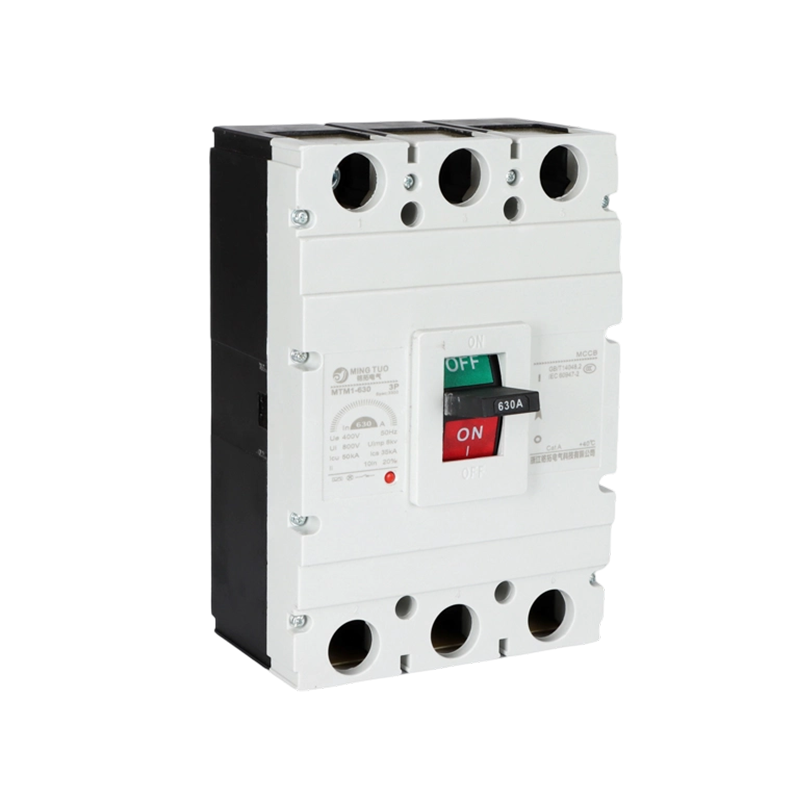
Single-pole devices are excellent for final circuits, but they have limits. If you need to switch the neutral, protect a three-phase motor, or handle currents above 63 A, a different device is required. For larger low-voltage feeders, a molded case circuit breaker is often the right step. Mingtuo Electric manufactures MCCBs from 63 A to 1600 A, including 3-pole and 4-pole versions for distribution boards and machine control panels.
 MT-M1 3/4-Pole AC Molded Case Circuit Breaker, 63A–1600AFor larger low-voltage feeders beyond single-pole MCBs, this 3/4-pole MCCB covers 63–1600 A and up to 400 V AC, with IEC/GB certification.View Product →
These breakers provide higher breaking capacity, adjustable trip units on some models, and a robust mechanism for industrial duty. They are not a replacement for a single-pole MCB on a lighting circuit, but they are the correct choice when the circuit grows beyond the final branch.
Based in Liushi, Zhejiang, Mingtuo Electric works within one of China's most complete low-voltage electrical supply chains. We focus on research, development, and manufacturing of low-voltage and medium-voltage circuit breakers, and we support customers with customizable solutions for industrial, commercial, and residential distribution. Our production philosophy is built around a complete manufacturing chain and 7S management, with the goal of stable quality and low return rates. You can learn more about our manufacturing background or read our LV and MV circuit breaker guide for a wider view of protection selection.
It means the breaker switches and protects only one live conductor, usually the phase in a single-phase circuit. The neutral is connected separately.
Yes. Single-pole MCBs are commonly rated 230/240 V AC and are used in single-phase final circuits.
A 6 A or 10 A MCB with B or C curve is typical, but the cable size and local code must be checked.
No. A three-phase load needs a three-pole or four-pole breaker that opens all live conductors together.
A miniature circuit breaker single pole is a small component with a serious job. Choose the right current rating, curve, and breaking capacity, install it correctly, and it will protect people and property for years. If your project moves beyond final circuits into larger distribution, Mingtuo Electric is ready to help you select the right circuit breaker for the job.
Zhejiang Mingtuo Electrical Technology Co., Ltd. All Rights Reserved.
Electrical Protection Circuit Breakers Medium Voltage Circuit Breakers Manufacturers Low Voltage Circuit Breakers Factory
